
No Premium Foreigner Charges: Our Commitment to Fair and Transparent Healthcare Pricing
Read about No Premium Foreigner Charges: Our Commitment to Fair and Transparent Healthcare Pricing on Wonderful Plastic Surgery
Imagine needing urgent medical care abroad, only to discover a "free" national health service might charge you over $1,200 per day for a hospital bed. This happens simply because you are a non-resident.
This isn't an isolated incident. It's a stark example of the confusing, often unfair reality of global healthcare pricing. Non-residents frequently face premium and unexpected costs.
For foreigners, navigating different insurance models and surprise "out-of-network" charges creates immense financial anxiety. A profound lack of clear information further transforms a health need into a stressful financial burden.
Our commitment to a single, fair price for everyone is a fundamental pillar of ethical medical practice, essential for empowering your healthcare journey with confidence.
TL;DR
Navigating global healthcare costs often feels like solving a complex puzzle, especially for international patients. Many systems, from government-run to insurance-based, intentionally obscure pricing, leading to confusion. This complexity frequently results in non-residents facing surprise bills and premium charges not applied to locals, even in countries with supposedly universal healthcare.
Despite efforts to mandate price transparency—a 2023 report found only 24.5% of 2,000 sampled US hospitals were fully compliant with transparency rules—the reality remains challenging. For instance, nearly 20% of patients undergoing in-network elective surgeries still receive surprise bills. This clearly shows current initiatives often fall short in providing clear, upfront cost information. For example, a UK hospital bed can cost a non-resident $1,200-$3,000 per day, highlighting vast discrepancies.
Our model champions an ethical pricing standard: one service, one price, for everyone. This approach provides itemized, upfront estimates, pairing cost with relevant quality data to empower patient choices.
Note: Patients should feel confident and empowered to demand detailed cost breakdowns from any provider before agreeing to treatment, ensuring complete transparency.
This article breaks down the complexities of international healthcare costs to champion a new standard of financial clarity and fairness.
The Global Healthcare Pricing Maze: Why Costs Are So Confusing
The global landscape of healthcare funding is incredibly diverse, leading to significant price variations and complexity that can be daunting for international patients. There isn't a single, standardized system, but rather four primary models that fundamentally shape how medical services are paid for.

These include the Beveridge model (government-run, like the UK’s NHS), the Bismarck model (employer/employee insurance, like Germany), the National Health Insurance model (private providers, public payer, like Canada), and the Out-of-Pocket model (direct patient payment).
It is crucial to understand that "universal healthcare" does not equate to "free for non-residents." These systems are typically funded by citizen taxes and contributions, meaning visitors and temporary residents are often excluded from free or subsidized care. Brazil stands as a notable exception, being the only country that constitutionally offers healthcare free for everyone, including visitors. In most nations, non-residents face high out-of-pocket costs, challenging the perception of universal access.
Price variation is not only systemic but can also be extreme, even within a single healthcare market. The same medical procedure can carry vastly different price tags. For example, New York Times data reveals that a colonoscopy at a single US hospital could cost $2,144 for an Aetna insured patient versus $1,463 for a Cigna patient. Such disparities underscore the opaque nature of medical billing and the lack of price transparency.
Adding to the confusion is the terminology itself. Words like ‘cost,’ ‘charge,’ ‘negotiated price,’ ‘deductible,’ and ‘coinsurance’ create layers of complexity. Patients often struggle to discern what they are truly expected to pay versus what an insurer or hospital simply "charges." This linguistic barrier further complicates the financial aspect of international medical care.
The lack of a standardized global system for healthcare funding creates a confusing and unpredictable pricing environment for international patients.
The 'Foreigner Fee': Uncovering Hidden Costs and Common Traps
Navigating healthcare systems in a new country can feel like solving a complex puzzle, especially when unexpected costs surface. For international patients and non-residents, the journey often involves more than just medical challenges; it frequently includes a hidden layer of financial uncertainty. These subtle, and sometimes overt, pricing structures create significant vulnerability, transforming what should be a straightforward medical experience into a minefield of potential overcharges.
One pervasive issue is surprise billing, a common trap even for those who diligently choose in-network facilities. Patients might find themselves treated by an out-of-network provider, like an anesthesiologist, during an otherwise in-network elective surgery. The result? A separate, massive bill that arrives weeks later. Disturbingly, various healthcare studies highlight that nearly 20% of patients undergoing in-network elective surgery still receive these unexpected charges.
Navigating Public vs. Private Systems
Many public healthcare systems around the globe are stretched, leading to extensive wait times. For instance, in the UK, over 20% of patients face waits exceeding six weeks for NHS imaging, pushing even locals with supplementary insurance toward private providers. Foreigners, without local insurance or navigating unfamiliar systems, are frequently directed to private care by default. While private care can offer quicker access, it almost invariably comes with a significantly higher price tag, a cost many patients are unaware they could potentially avoid or negotiate.
Adding to this complexity is the ongoing struggle for true pricing transparency. Despite calls for clearer communication, provider non-compliance with transparency rules remains a major issue. A 2023 report indicated that a mere 24.5% of sampled US hospitals were fully compliant with mandates to post their prices online. This lack of accessible, clear information leaves patients guessing, making it nearly impossible to compare costs effectively before receiving care.
The Price-Quality Illusion
Another critical factor affecting patient decisions is the psychological link between price and perceived quality. Without readily available quality metrics, patients often incorrectly assume that a higher price guarantees superior care. Research consistently shows that when objective quality information is absent, individuals tend to associate higher costs with higher quality services. This perception, while understandable, can unfortunately be exploited by providers, leading patients to opt for more expensive treatments without necessarily receiving better outcomes.
Systemic issues like surprise billing, a lack of transparency, and the price-quality illusion leave international patients uniquely vulnerable to financial exploitation.
Global Price Transparency Rules: A Noble Effort with Flawed Execution
The global push for clearer healthcare pricing reflects a widespread desire for fairness and patient empowerment. Governments worldwide have recognized the need for greater visibility into medical costs, leading to significant regulatory actions. In the United States, for example, robust mandates require hospitals and insurers to post their prices online in machine-readable formats. Since January 2021, US hospitals must publish charges and negotiated prices, followed by insurers publishing machine-readable files of negotiated rates as of July 2022. This represents a noble effort, intending to equip patients with the information needed to make informed decisions.
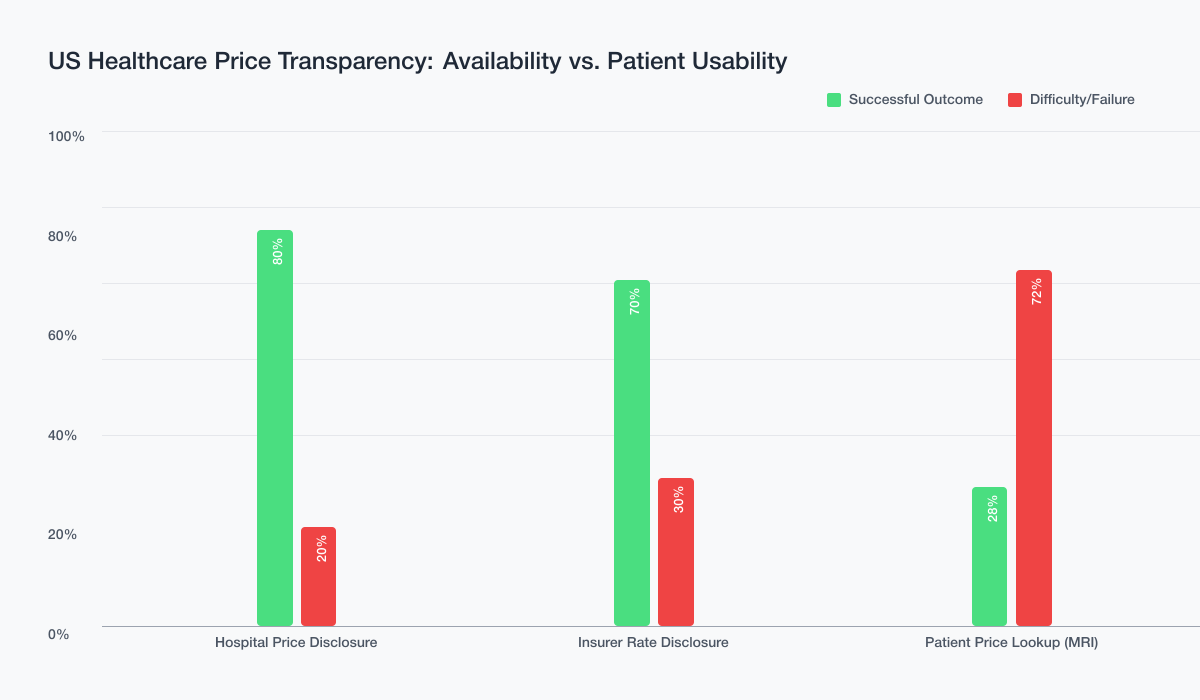
However, the journey from legislative intent to practical utility has been fraught with challenges. The usability of these mandated tools is often extremely low, hindering their effectiveness. A study found that only 27.7% of participants could accurately find a price estimate for an MRI using hospital-provided online tools. This highlights a critical gap between the availability of data and its accessibility for the average patient.
Barriers to Effective Price Comparison
Several factors contribute to this flawed execution:
- Inconsistent Naming Conventions: Medical services often lack standardized terminology across different providers. What one hospital lists as a 'lumbar spine MRI' might be called a 'spinal canal MRI' or 'lower back MRI' elsewhere. This inconsistency makes it incredibly difficult for patients to compare like-for-like services.
- Single-Service Focus: Most current tools provide a price for an individual service. Yet, a complete healthcare episode—such as a diagnostic test, a physician’s consultation, and subsequent treatment—often involves multiple providers and services. The estimate for a single MRI, for instance, rarely includes the radiologist's fee or the follow-up consultation, leading to a final bill significantly higher than the initial estimate.
- Low Compliance: Despite mandates, compliance remains a hurdle. Many institutions have been slow to implement the rules fully or provide data in truly user-friendly formats.
These shortcomings mean that while the data technically exists, it's often buried in complex files or presented in a way that is challenging for patients to interpret. This lack of practical usability is frustrating, especially given that a YouGov poll found 91% of Americans support mandatory price disclosure by healthcare facilities.
While government mandates for price transparency are a positive step, poor execution, low compliance, and flawed tools have prevented them from truly empowering patients.
Our Commitment: One Price for Everyone, Guaranteed
At our organization, we believe that an ethical approach to healthcare pricing is built on a simple, unwavering promise: to eliminate ambiguity and offer a single standard of fair, predictable costs to every patient. We understand the frustrations and anxieties caused by hidden fees and complex billing. That’s why our commitment centers on transparency and equity, ensuring everyone receives the same considerate treatment.
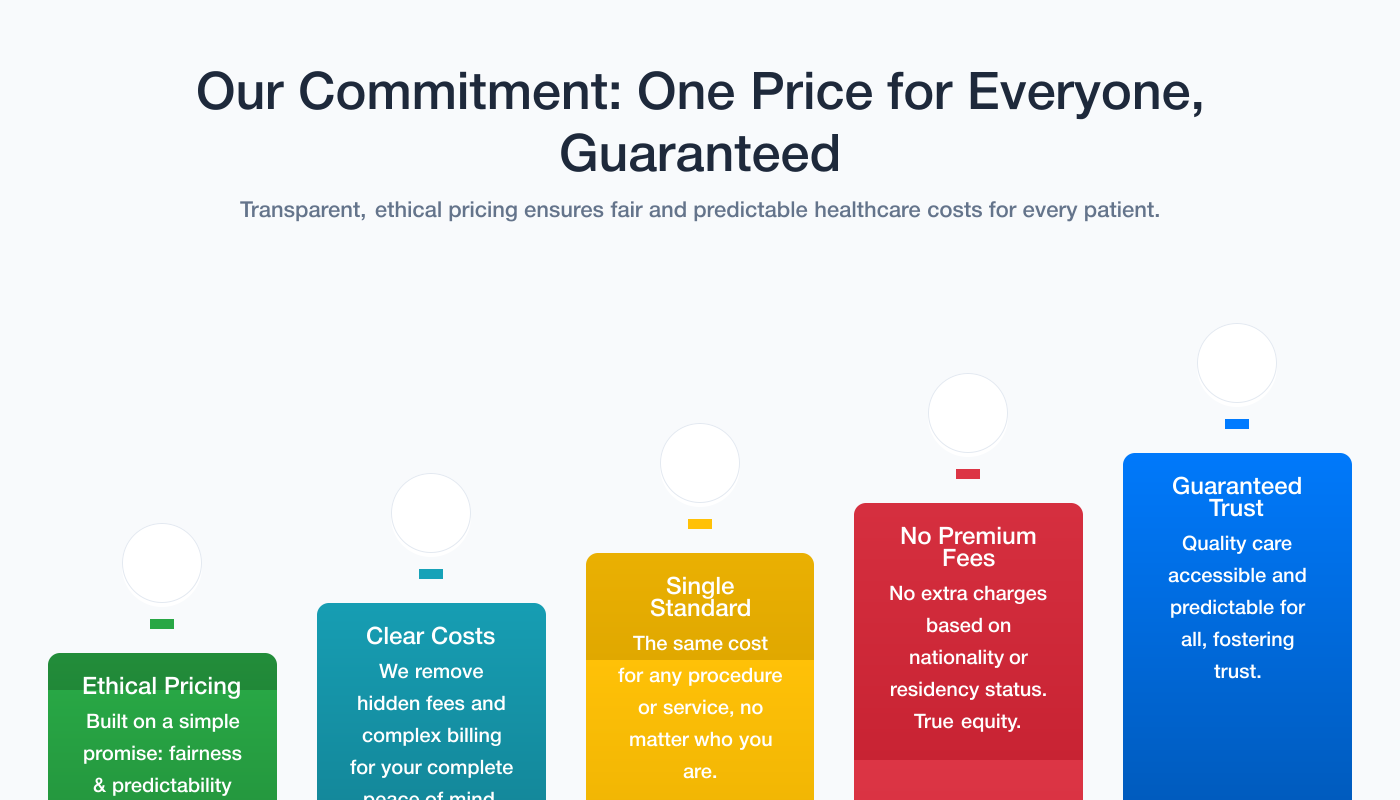
Our cornerstone is a clear 'One Price' policy: the cost for any procedure or service is precisely the same, regardless of whether you are a local resident or an international visitor. We firmly reject the practice of imposing premium charges based on nationality or residency status. This principle ensures true fairness, making quality healthcare accessible and predictable for all and fostering an environment of trust from your very first inquiry.
Comprehensive Estimates, No Surprises
We pride ourselves on providing clarity from the outset. Before any commitment is made, every patient receives a comprehensive, itemized estimate. This detailed breakdown bundles all anticipated costs, including professional fees, facility charges, standard supplies, and any associated follow-up care that can be foreseen. Our goal is to ensure you know the full financial picture upfront, meaning absolutely no hidden fees or surprise bills will emerge after your treatment.
Note: We reject inflated 'chargemaster' or arbitrary list prices. Our estimates are meticulously calculated based on the actual, transparent costs of providing exceptional care, ensuring value without compromise.
Furthermore, we are dedicated to clear communication. We provide plain-language explanations of our services and pricing, consciously avoiding confusing medical jargon. This empowers patients to fully understand their treatment options and associated costs, enabling them to make truly informed decisions. Studies show that when given actionable price information, patients are more likely to choose affordable, high-value providers. A LUGPA/YouGov poll indicated that 66% of consumers are willing to shop for care if given the ability. By offering clear cost and quality data, we help patients select high-value care that aligns with their needs and budget.
Our 'One Price' policy guarantees the same fair cost for every patient, local or international, with a comprehensive, itemized estimate provided upfront.
The intricate world of global healthcare pricing doesn't have to remain a source of anxiety. Our journey through the hidden complexities, unfair "foreigner fees," and flawed transparency initiatives reveals a clear path towards a more ethical and patient-centric model. An ethical approach dismantles these barriers by championing a single, fair price for services regardless of nationality, supported by clear, itemized estimates and quality data. As you navigate your healthcare journey, empower yourself by demanding this level of clarity from any provider. Seek institutions that champion the principle of one price for everyone, demonstrating a genuine commitment to fair and transparent healthcare for all.
Ultimately, empowering patients with financial clarity is as crucial as providing exceptional medical care, fostering the trust needed to focus entirely on your well-being.
Tags
Related Articles

Online Consult Savings: The Shocking Truth About Korean Plastic Surgery

The Rise of K-Dermatology: Why South Korea is the Global Capital for Skin Health Tourism