
The Pursuit of Perfection: Why a Zero-Accident Record in Surgery is the New Standard of Care
Read about The Pursuit of Perfection: Why a Zero-Accident Record in Surgery is the New Standard of Care on Wonderful Plastic Surgery

For too long, the medical community has, perhaps inadvertently, accepted a certain level of "unavoidable" risk and error within surgical care. We\u2019ve celebrated successful outcomes, even as preventable harms silently impacted patients worldwide. But what if this long-held perspective is fundamentally flawed? What if achieving a truly zero-accident record in surgery isn't an idealistic dream, but an urgent, achievable standard of zero harm?

This exploration will challenge existing paradigms, moving beyond traditional safety protocols to envision a future where preventable surgical errors are eradicated. Every patient deserves nothing less than flawless care and absolute peace of mind, making a zero-accident record in surgery an urgent, achievable standard.
TL;DR
Achieving superior surgical safety transcends traditional measures. A clear shift towards zero harm is now imperative, transforming patient care from reactive to proactively flawless. This patient-centric goal demands dedicated commitment and a comprehensive, multi-faceted approach.
Key elements for this new standard include:
- Implementing rigorous standardized protocols, such as checklists, demonstrably reduce errors (WHO, 2023).
- Cultivating a robust safety culture fostering open, non-punitive reporting mechanisms.
- Demonstrating visible and engaged leadership to champion safety initiatives effectively.
- Leveraging advanced technology and data analytics for predictive prevention.
- Targeting specific strategies to eradicate 'never events' like wrong site surgery.
Ultimately, embracing a comprehensive, integrated strategy is essential to achieve truly exceptional surgical safety.
The Unsettling Reality: Understanding the Current Landscape of Surgical Errors
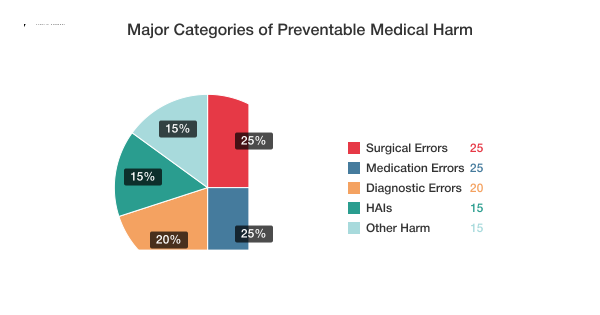
Despite remarkable medical progress, patient safety remains a significant challenge. Approximately 10% of all hospitalized patients experience some form of harm (Jain et al., 2025). This reality affects countless lives.
Medical errors are a leading cause of death. Medication errors alone contribute to 250,000 deaths annually in the U.S. (Performance Health US). The operating room (OR) is a complex adaptive system where diverse personnel, advanced technology, and unconscious patients interact. This intricate environment inherently elevates error potential (Gibbs, 2012).
Categories of errors deemed never events—those considered entirely preventable—persist in surgical settings. Key preventable events include wrong site surgery, retained surgical items (RSI), and surgical fires. Individually rare, their collective persistence is alarming.
Despite protocols, wrong site, wrong procedure, and wrong patient surgeries still occur over 40 times a week in the United States (Gibbs, 2012). This frequency contradicts their 'never event' designation, revealing prevention gaps and systemic vulnerabilities.
These persistent failures underscore an urgent need for a reimagined approach to surgical safety, aiming for true zero harm.
Defining "Zero Harm": A New Standard, Not an Unattainable Utopia
The idea of a "zero harm" record in surgery was once seen as an idealistic fantasy. However, this perspective is swiftly changing. Today, zero harm defines a concrete, transformative commitment. It aims to systematically eliminate preventable patient injuries through diligent, proactive design and continuous improvement. This ambitious, patient-centric goal focuses on eradicating all preventable adverse events (Performance Health US).
This philosophy fundamentally rejects the outdated notion that some harm is simply inevitable in healthcare. Instead, it demands a proactive approach, shifting focus entirely to anticipating and preventing risks. Achieving this standard goes beyond just following protocols. It drives profound transformation across culture, leadership, and innovation within medical institutions (Performance Health US). Such a commitment requires rethinking entire care systems, fostering deep collaboration and coproduction among all involved.
The feasibility of this standard is clearly demonstrated by real-world successes. Mackenzie Health, for instance, implemented a zero-harm philosophy with impressive results in under a year. They increased patient safety incident reporting by 37%, decreased falls by 39%, and reduced pressure injury rates by 37% (Performance Health US). These outcomes prove that striving for zero harm, though challenging, is profoundly achievable. As an ideal, it motivates continuous improvement (Jain et al., 2025).
Note: The focus is always on preventable harm, recognizing human factors while demanding systemic resilience.
This commitment reshapes how we approach patient safety, moving beyond reactive fixes to build genuinely secure environments. Embracing a zero-harm standard is an achievable imperative for truly superior patient care.
Pillar 1: Standardized Protocols and Checklists - The Bedrock of Surgical Safety

The intricate nature of surgical procedures demands unwavering precision and consistency. Standardized protocols are crucial here, serving as the most effective mechanism to prevent harm by significantly reducing variability in care delivery (Performance Health US). This approach creates a reliable framework, ensuring that every patient receives consistently high-quality care.
A prime example of this commitment to standardization is the WHO Surgical Safety Checklist. This 19-item, universally applicable tool has fundamentally reshaped surgical practices worldwide, acting as a powerful safeguard against preventable errors. Its rigorous implementation has demonstrably enhanced patient safety, improving teamwork and communication among surgical teams (Jain et al., 2025). It moves beyond informal procedures to a structured, team-oriented approach.
The checklist is structured around three crucial verbal pauses, ensuring critical information is shared and confirmed at key junctures:
- Sign-in: Performed before anesthesia induction, confirming patient identity, surgical site, planned procedure, and known allergies.
- Time-out: Executed immediately before the surgical incision; the entire team collectively verifies the correct patient, site, and procedure, confirms equipment availability, and proactively addresses any potential critical events.
- Sign-out: Conducted before the patient leaves the operating room; the team reviews the completed procedure, addresses instrument and sponge counts, labels all specimens correctly, and plans for postoperative recovery.
These structured pauses directly combat common sources of error, fostering a culture of collective responsibility and proactive problem-solving. Global data confirms a marked decline in mortality and morbidity rates linked to the checklist's widespread adoption (Jain et al., 2025). This evidence firmly refutes any notion of it being a mere procedural formality; its tangible outcomes highlight its profound value in clinical practice.
Note: The systematic nature of checklists ensures all necessary steps are meticulously followed, providing a consistent framework regardless of the individual clinician or specific facility. This directly addresses variability, a significant contributor to adverse events in surgery.
Standardized protocols, epitomized by the WHO Surgical Safety Checklist, are the non-negotiable foundation for achieving a truly zero-accident surgical standard.
Pillar 2: Cultivating a Culture of Psychological Safety and Open Communication
A truly safe surgical environment begins not with technology, but with trust. Creating a culture of psychological safety empowers every healthcare professional to voice concerns, report errors, and ask questions without fear of blame or reprisal. This open dialogue is fundamental to identifying risks before they lead to harm and fostering continuous improvement within the operating room and beyond.
When staff feel secure, they become proactive guardians of patient well-being. This proactive approach significantly impacts safety outcomes, as statistical evidence demonstrates a strong correlation between robust safety cultures and reduced adverse events. Higher safety culture scores are associated with a remarkable 76% reduction in adverse events (Performance Health US).
Moving beyond a punitive 'person approach' is essential for meaningful progress. Instead of blaming individuals for mistakes, a 'system approach' analyzes the underlying conditions, human factors, and systemic failures that contribute to errors (Gibbs, 2012). This perspective allows teams to implement enduring solutions, creating stronger defenses against future incidents rather than merely addressing symptoms.
Note: Supporting colleagues who make mistakes, rather than immediate condemnation, is vital for a learning environment. Such empathy, encouraged by official guidelines (Jain et al., 2025), reinforces a culture where learning from errors takes precedence over fear.
Finally, integrating patients and their families into the safety dialogue provides invaluable insights. Their unique perspectives can help identify shortcomings in care and quality, fostering transparency and building crucial trust between providers and the communities they serve (Jain et al., 2025). This collaboration transforms patients from recipients of care into active partners in their safety journey.
A genuinely safe surgical environment is built upon a foundation of psychological safety where open communication, collaborative learning, and non-punitive error analysis are actively encouraged and protected.
Pillar 3: Leadership's Imperative - Driving and Sustaining the Zero Harm Vision

Achieving a zero-accident record in surgery hinges on strong, visible leadership. Leaders are the foundational architects, shaping an organization's vision for patient safety and its operational reality.
For a 'zero harm' culture to thrive, leaders must actively engage. This means visible participation in safety trainings, promoting initiatives, and conducting regular check-ins (Performance Health US). Such active presence is crucial for setting the organizational safety tone.
The Joint Commission underscores this imperative, issuing a sentinel event alert calling for leadership action to develop effective safety cultures (Performance Health US). This highlights that top-down commitment is not merely beneficial, but critical for progress.
Leaders translate commitment into measurable action by establishing clear performance metrics and integrating best practices. They track incident reports, analyze near misses, and adopt frameworks like The Joint Commission[u2019]s \u201cLeading the Way to 0\u201d campaign (Performance Health US). This proactive approach moves beyond compliance, transforming safety into a relentless pursuit of excellence.
Note: Visible leadership empowers staff to report safety concerns openly, fostering a culture of trust and continuous improvement.
Key actions for leaders include:
- Active engagement in safety protocols.
- Ensuring adequate resources.
- Transparently communicating performance.
Effective, engaged leadership is the indispensable force translating 'zero harm' into concrete, measurable improvements and an enduring safety culture.
Pillar 4: Leveraging Technology and Data for Predictive Prevention

Integrating cutting-edge technology and sophisticated data analytics transforms surgical safety from a reactive process into a proactive, intelligent system capable of predicting and preventing harm. This paradigm shift is essential for achieving a zero-accident record, moving beyond traditional incident response to anticipating potential risks.
Modern incident management software forms the bedrock of this proactive approach. These systems allow for systematic tracking, reporting, and in-depth analysis of adverse events and near misses. By meticulously collecting this data, healthcare teams can identify recurring patterns and pinpoint the root causes of safety breaches, informing targeted improvements (Performance Health US).
The true innovation lies in AI-powered predictive analytics. These advanced tools analyze vast datasets to identify patients at high risk of adverse events well before they occur. This enables clinicians to develop personalized, risk-minimized care plans, intervening proactively to safeguard patient well-being (Performance Health US).
Beyond the operating room, telehealth capabilities significantly expand access to care and reduce potential harm. Virtual consultations, for example, minimize infection spread by limiting physical contact, while enabling continuous patient monitoring from a distance (Performance Health US). Complementary to this, mobile health applications empower patients to actively manage their conditions, track symptoms, and maintain seamless communication with their care providers, fostering a collaborative and safer care journey (Performance Health US).
Hospitals that fully embrace a zero-harm philosophy through technology integration demonstrate remarkable improvements. Mackenzie Health is a prime example, achieving increased patient safety incident reporting by 37%, a 39% decrease in falls, and a 37% reduction in pressure injury rates within less than a year, alongside elevated patient safety awareness among clinical teams (Performance Health US). Their success underscores how technology empowers a comprehensive, preventive safety culture.
By intelligently deploying technology and data, surgical care transitions from managing errors to actively preventing them, forging a truly proactive safety culture.
Spotlight on "Never Events": Targeted Prevention Strategies

"Never events" represent serious, preventable errors in healthcare that simply should not occur. In surgery, these incidents undermine patient trust and can lead to severe harm. Achieving a zero-accident record means diligently addressing these specific, critical risks with unwavering commitment.
Now, let's explore detailed strategies for preventing the most common and critical 'never events' to foster a safer surgical environment.
Wrong Site Surgery: Precision Through Protocol
Wrong site surgery, encompassing wrong patient, wrong procedure, or wrong site operations, remains a profound concern. These errors often stem from breakdowns in patient identification or procedural verification processes (Gibbs, 2012).
The Universal Protocol is the cornerstone for preventing these devastating mistakes. It mandates a rigorous, multi-step verification process to confirm the correct patient, site, and procedure:
- Complete a preoperative verification process to confirm patient identity, procedure, and site.
- Mark the operative site clearly and unambiguously, typically performed by the surgeon and visible post-draping.
- Conduct a mandatory "time-out" just before incision, involving the entire surgical team, to collectively re-verify all critical information.
Alarmingly, errors introduced during the initial verification step contribute to 39% of wrong site surgery risks (TJC, cited by Gibbs, 2012). This highlights the critical need for absolute vigilance from the very first interaction.
Vigilant adherence to the Universal Protocol at every stage is non-negotiable for preventing wrong site surgery.
Retained Surgical Items (RSI): Beyond Manual Counts
Retained Surgical Items (RSI), most frequently sponges, needles, or instrument fragments, can lead to serious complications for patients (Gibbs, 2012). A concerning reality is that manual sponge counting alone is often insufficient for prevention.
Approximately 80% of retained sponge cases occur despite a documented "correct count" (Gibbs, 2012). This statistic strongly discredits reliance solely on traditional manual methods and underscores the need for enhanced strategies.
Advanced Sponge ACCOUNTing practices are vital. This includes grouping sponges in tens, performing methodical wound examinations, and visual team confirmation during counts. Moreover, technological adjuncts are proving highly effective:
- Mayo Clinic reported zero retained sponges over 18 months using a 2D matrix system (cited by Gibbs, 2012).
- Similarly, UNC achieved zero retained sponges over 24 months with an RF detection system (cited by Gibbs, 2012).
These examples demonstrate the irrefutable efficacy of integrating technology with meticulous manual protocols.
A multi-modal approach combining robust manual protocols with advanced technology is essential to eliminate RSIs.
Preventing Surgical Fires: Mastering the Triad
While preventing physical items from being left behind is vital, another catastrophic 'never event' is surgical fires. These rare but devastating incidents require the classic 'fire triad': an oxidizer, an ignition source, and fuel (Gibbs, 2012).
Prevention hinges on understanding and proactively managing each component of this triad. By breaking any one leg, a fire cannot occur. Clear role assignments empower the surgical team to control specific risks:
- Anesthesiologists meticulously manage oxidizers, such as oxygen and nitrous oxide flow.
- Nurses are crucial for monitoring and controlling fuel sources, including surgical drapes, alcohol-based skin preps, and patient tissue.
- Surgeons maintain control over ignition sources, like electrosurgical units, lasers, and fiber optic light cords.
Constant situational awareness and case-specific risk assessments are paramount, particularly during high-risk procedures near the airway. A proactive, collaborative approach ensures every team member contributes to fire prevention.
Preventing surgical fires demands a structured, collaborative team effort focused on breaking the fire triad.
By systematically implementing these targeted prevention strategies, surgical teams can significantly mitigate the risks associated with "never events." Embracing a culture of meticulous protocols, leveraging proven technology, and fostering unwavering team responsibility are the cornerstones of delivering truly safe surgical care. The pursuit of perfection in surgery is not merely an aspiration; it's a fundamental commitment to patient safety.
The aspiration for a zero-accident record in surgery is no longer an idealistic dream but an evolving reality—a critical imperative that is rapidly establishing itself as the new standard of care. This commitment to 'zero harm' elevates patient safety from an operational goal to a foundational principle, shaping every aspect of surgical practice.
Achieving this transformative standard requires a multifaceted approach:
- Systemic Transformation: Moving beyond basic protocols, zero harm demands a comprehensive, integrated, and proactive approach to surgical safety, addressing every potential point of error.
- Culture of Safety: A robust safety culture, nurtured by engaged leadership and open communication, is fundamental. It empowers every team member to identify risks and contribute actively to patient protection.
- Technological Advancement: Leveraging advanced technology and sophisticated data analytics is essential for predictive prevention, enabling healthcare providers to anticipate and mitigate potential errors before they ever occur.
While the journey towards absolute perfection is continuous, dedicating ourselves to these principles ensures a future where preventable surgical errors are truly eradicated, providing profound reassurance and peace of mind to every patient.
For healthcare institutions and dedicated professionals, embracing these advancements is not just an option—it is a profound ethical responsibility to pioneer safety, foster trust, and ensure paramount patient well-being.
Tags
Related Articles

How to Choose the Right Plastic Surgeon in Korea: A Guide for International Patients

Top 2025 Plastic Surgery Trends in Korea: The Future of Beauty is Here